
Now that artificial intelligence has reached broad commercial status in consumer and enterprise applications, AI in manufacturing has begun to take hold as well. This technology has real potential to dramatically improve manufacturing quality, productivity, and cost efficiency over the coming years. Unfortunately, it also has the potential to generate a wave of overpromised, underdelivered products — "Driven by AI" becoming the latest version of "New and Improved," signifying marketing ambition rather than production-ready capability.
As you explore opportunities to apply AI to your manufacturing quality program, the question is: how do you tell the difference?
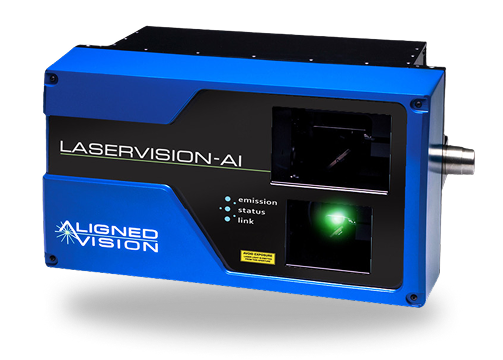
At Aligned Vision, we have spent the past five years working with AI quality specialists and developing our own expertise in this domain. Our specific application is AI-driven inspection with LASERVISION, our large-field automatic inspection system — already deployed in production at major aerospace manufacturers. Here is what we have learned about what it actually takes for AI to work in a manufacturing quality context.
Prerequisite 1: The System Must Use Your Design and Engineering Data
The entire point of AI in manufacturing quality is to verify that what was built accurately matches what was designed. That requires more than simply having access to CAD/CAM data — it requires a system that can actively use that data to drive the inspection process.
Specifically, a production-ready AI inspection system must be able to:
- Translate a virtual design representation into actual physical attributes on the work-in-progress (WIP) — material position, fiber orientation, fastener location, and similar features
- Locate those attributes within the 3D coordinate system of the factory floor or work cell, accounting for part position and orientation
- Capture those attributes in a way that enables automatic comparison to the CAD/CAM specification — including detecting what should not be present, such as foreign object debris (FOD)
LASERVISION has a significant advantage here because it is built on top of Aligned Vision's decades of development in CAD-driven laser projection. The optical aiming system — including error correction that eliminates optical distortion — was developed and refined over years of laser projection applications before AI inspection was layered on top of it. The CAD/CAM transparency that is a prerequisite for AI quality is already a proven, production-tested component of the LASERVISION platform.
Prerequisite 2: The System Must Capture Sufficient Image Quality
"If you don't have enough pixels, AI can't learn." This observation from an AI industrial expert identifies the most commonly underestimated prerequisite for AI inspection in manufacturing.
To train an AI model for defect detection, you need large quantities of image data that accurately represent your production surfaces, defect types, and material characteristics. If those images lack sufficient resolution or contrast, the AI algorithms trained on them will be inadequate — regardless of how sophisticated the underlying machine learning framework is. The problem cannot be solved at the algorithm level if it exists at the data level.
It is important to distinguish between camera resolution and pixel resolution. Camera resolution describes the sensor — it tells you about the camera hardware, not about the relationship between the camera and the surface being inspected. Pixel resolution measures what matters: the density of captured image data relative to the actual physical surface. Higher pixel resolution means smaller features are captured with more detail, more reliably, across the full field of view.
LASERVISION achieves ultra-high pixel resolution through its optical system design: a 150mm high-magnification lens, high dynamic-range sensor, and transform-driven AutoFocus. Positioned 3 meters from the inspection surface, a standard LASERVISION unit captures 1.5 gigapixels across 9 square meters — or 167 megapixels per square meter. This is the resolution foundation that makes LASERVISION's AI algorithms reliable in production.
Prerequisite 3: The Platform Must Be Open
In the early stages of any emerging technology, specialized expertise creates barriers that make the technology impractical for broad commercial deployment. AI in manufacturing has followed this pattern. Early implementations required highly specialized resources and extensive development timelines that were simply incompatible with production schedules.
Today, AI can be applied to manufacturing quality programs by production engineers and quality teams — as long as the underlying platform is open. A proprietary, closed platform requires the manufacturer to work exclusively through the technology vendor for all algorithm development, updates, and integrations — creating a bottleneck that slows deployment and limits adaptability.
An open platform enables two critical capabilities:
Rapid application development
LASERVISION ships with built-in analysis algorithms for the most common inspection attributes: fiber orientation, material and edge location, and FOD detection. For application-specific requirements, Aligned Vision's engineers can develop additional algorithms — typically within 24–48 hours for an initial model. Because LASERVISION is compatible with any PC-based vision software, customers with in-house or third-party AI development teams can work directly with the platform. You are not locked into a single development pathway.
Closed-loop continuous improvement
Every inspection LASERVISION performs generates structured as-built data: calibrated images, detected anomalies, corrective actions, timestamps, and operator identifiers. Because LASERVISION operates on an open platform, this data flows directly into your enterprise software — manufacturing execution systems (MES), enterprise resource planning (ERP), product lifecycle management (PLM). Many of these systems now include AI deep learning capabilities that can analyze as-built data alongside design and process data to surface manufacturing insights: patterns in defect occurrence, correlations between process parameters and quality outcomes, opportunities to tighten allowables or simplify design.
This is the Quality 4.0 model — inspection not as a periodic checkpoint, but as a continuous source of manufacturing intelligence. Closed-loop continuous improvement driven by as-built data is what separates manufacturers who use AI to get to six sigma from those who use it to push beyond it.
Evaluating AI Inspection Claims: A Practical Framework
Given the proliferation of "AI-powered" claims in manufacturing technology marketing, here is a practical framework for evaluating whether a system is genuinely production-ready:
- Does it use your CAD/CAM data actively to drive inspection — or does it simply process images without design context?
- What is its pixel resolution at your specific standoff distance and field of view? Has this been measured and documented, not just claimed?
- Has the system been deployed in production — not just demonstrated in a lab — and at what Technology Readiness Level (TRL)?
- What is its documented inspection accuracy, and how was that accuracy measured? Look for statistical rigor, not marketing claims
- Is the platform open for integration with your enterprise software and your AI development resources?
- What algorithm development support does the vendor provide, and what is the typical time from data collection to a production-ready inspection model?
LASERVISION has achieved TRL-9 in aerospace production applications, has demonstrated beyond six sigma inspection reliability (1 in 2.5 billion false positive probability), and has reduced inspection time by more than 95% compared to manual methods. These are not lab results — they are production outcomes documented across thousands of builds.
The Bottom Line
AI has genuine, proven potential to transform manufacturing quality — but realizing that potential requires more than attaching an AI label to an existing product. It requires CAD/CAM integration that connects inspection to design intent, image quality sufficient to train reliable detection algorithms, and an open platform that enables both rapid application development and continuous improvement through as-built data.
Manufacturers who deploy AI inspection systems with these fundamentals in place are not just improving their inspection step — they are building the data infrastructure for ongoing quality optimization that compounds over time.
Interested in seeing LASERVISION's AI inspection capabilities in your application? Contact Aligned Vision today for an online or onsite demonstration.
aligned-vision.com