
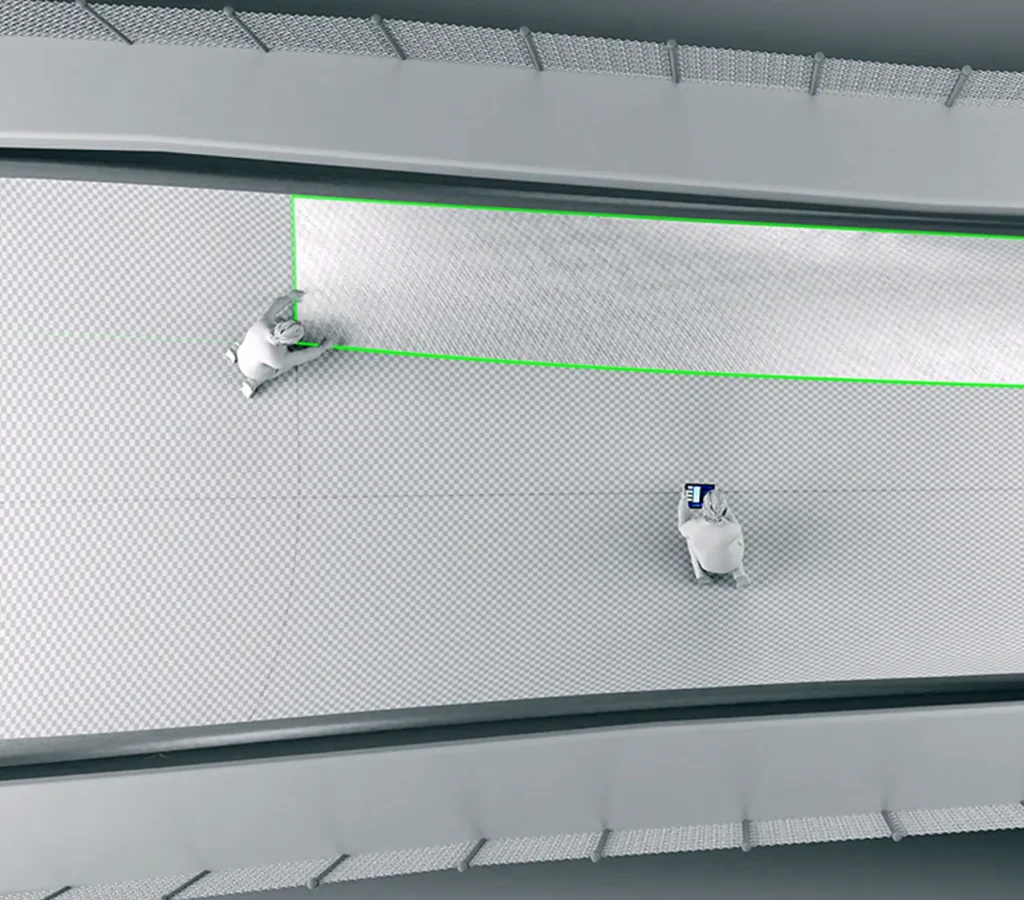
Use case: In-process inspection of wind turbine blades In a perfect world, adopting new digital technology would be an exciting milestone for any manufacturer. Digitalization in manufacturing promises significant improvements in product quality and substantial operational cost savings. Automatic in-process inspection with LASERVISION, for example, delivers beyond six sigma reliability while reducing inspection times by up to 95%.
In the real world, however, the prospect of a digitalization project understandably gives many manufacturers pause. Industry experts estimate that 70% of digital transformation efforts in manufacturing fail to meet their goals. If you are hesitant about the risks of going digital — worried about disrupting current operations, making a costly wrong bet, or navigating a difficult implementation — this guide is for you.
At Aligned Vision, we have been minimizing digitalization risks for customers across aerospace, wind energy, and industrial manufacturing for over two decades. This guide walks through the three questions every manufacturer should answer before committing to a digital quality initiative — and shows how we approach each one with our wind blade manufacturing partners as a real-world example.
The three questions to answer before any digitalization investment:
1. Is the financial case sound — will the ROI justify the investment?
2. Will this system actually work for my specific application?
3. What will implementation actually require — and what will it disrupt?
Question 1: Is the Financial Case Sound?
One reason digitalization feels risky is that we naturally compare the unknowns of a new system to the familiarity and perceived safety of current operations. The status quo feels secure. But current operations carry their own costs — costs that often go unmeasured because they are buried in overhead rather than broken out as line items.
A rigorous financial assessment puts both sides of the ledger on equal footing. For LASERVISION, a comprehensive cost-benefit analysis should include:
Investment side:
- Initial system cost, tailored to your specific application and field of view requirements
- Recurring costs — software licenses, annual maintenance, support agreements
- Implementation costs — installation, training, parallel operation period
Savings side:
- Reduced rework and scrap: fewer undetected defects means less material and labor wasted on late-stage corrections
- Shorter cycle time: LASERVISION typically cuts inspection time from 30 minutes per surface to under 90 seconds — that is 28.5 minutes of productive capacity recovered per inspection, per operator, per shift
- Reduced operator idle time: operators are no longer waiting on a separate inspection step before proceeding to the next production task
- Lower skilled labor demand: automatic inspection reduces dependency on specialized inspectors whose knowledge is difficult to recruit, train, and retain
- Quality escape avoidance: for wind turbine blades, a single catastrophic failure caused by a missed defect can cost approximately $200,000 for the replacement blade, $350,000 per week for crane rental, and roughly $1,000 per day in lost energy production revenue — before accounting for reputational damage or warranty liability
That last category deserves particular attention. Quality escape costs are typically classified as "cost avoidance" — harder to count than direct savings, and therefore often underweighted in investment decisions. But a single missed defect in a flight-critical aerospace structure or a megawatt wind turbine can generate costs that dwarf the entire investment in prevention. When you assign realistic probabilities and costs to these events, the financial case for automatic inspection becomes compelling even before factoring in the operational savings.
Calculating the operational savings requires some investigation, since many of them surface from overhead rather than discrete line items. But with LASERVISION's well-documented performance data across multiple production environments, reliable estimates are achievable — and Aligned Vision's application engineers will help you build them.
Question 2: Will This System Work for My Specific Application?
Even if the financial case is clear, a second critical question remains: just because a technology works well in one environment does not automatically mean it will work in yours. Application fit is not guaranteed, and a system that underperforms in your specific context will not deliver the ROI you projected.
The right way to evaluate application fit is to compare your requirements against the system's proven performance envelope — and to work with a technology partner who will honestly tell you where there is alignment and where development work is needed.
The wind blade case study
LASERVISION was originally developed and proven for in-process inspection of large composite aerospace structures, where it inspects for fiber orientation, material and edge location, and foreign object debris (FOD) within a 5m x 5m field of view from approximately 5 meters away.
Wind blade manufacturers need to inspect these same attributes — but at a fundamentally different scale. Wind blade inspection requires a 15m x 15m field of view from 15 meters away. That is a nine-fold increase in inspection area. The AI algorithms, imaging hardware, and calibration approach all needed to be adapted for this environment.
Rather than telling wind blade manufacturers that the system would work and figuring it out later, Aligned Vision partnered with an academic institution and a leading wind blade manufacturer to formally develop and validate LASERVISION for this application. The result:
- Demonstration of multi-gigapixel resolution across the full 15m x 15m field of view
- Development of new AI analysis algorithms for wind-blade-specific attributes including wrinkles and core gaps — defect types not present in aerospace composite inspection
- Successful progression from prototype to beta testing in a production environment
This approach — applying existing capabilities where they fit, and innovating where they don't — is how Aligned Vision works with every new customer. We do not ask you to adapt your process to our technology. We adapt our technology to your process.
A note on resolution requirements
One application risk that is easy to underestimate is image resolution. Some manufacturers, seeking to minimize upfront costs, explore lower-cost camera alternatives — such as pan-tilt-zoom (PTZ) camera systems — before committing to LASERVISION. This is understandable. But PTZ cameras do not provide the minimum pixel resolution required for reliable defect detection in composite structures.
As one AI development expert put it plainly: "If you don't have enough pixels, AI can't learn." A system that captures insufficient image data will not achieve the inspection accuracy its AI algorithms are theoretically capable of — regardless of how sophisticated those algorithms are. Resolution is not a place to compromise.
Question 3: What Will Implementation Actually Require?
The third major concern manufacturers raise about digitalization is implementation: how long will it take, how much will it cost, and how much will it disrupt production? These are legitimate questions — and for LASERVISION, the answers are consistently more favorable than manufacturers expect.
Non-disruptive deployment by design
LASERVISION is designed from the ground up to deploy without disrupting production. Because the system operates on a large standoff distance and does not physically interact with the work-in-progress, it can begin capturing inspection images in the background while your existing production operations — including your current inspection protocol — continue normally. Your operators do not need to change their workflow during the data collection phase.
Development and lease contracts: a lower-risk path to ownership
For manufacturers who want to validate performance before committing to system ownership, Aligned Vision offers both development contracts and lease agreements. Our wind blade manufacturing partner chose a development contract — allowing LASERVISION to be deployed and validated in their production environment before ownership transferred. Lease agreements offer a similar risk mitigation path for manufacturers at an earlier stage of evaluation.
These arrangements work precisely because LASERVISION's implementation does not require a production stoppage or a parallel facility. The system comes to your shop floor, integrates into your existing workflow, and proves itself in your environment.
The implementation sequence
For a typical LASERVISION deployment, the sequence looks like this:
- Background data collection: LASERVISION is positioned at the WIP and captures calibrated images while production continues normally. For defect types that occur infrequently in production, Aligned Vision's laboratory captures additional images from production artifacts with deliberately created defects, ensuring the AI model is trained on the full range of conditions it will encounter
- Algorithm development: Aligned Vision's engineers — or your in-house or third-party AI team — develop inspection models from the collected image data. This typically requires 24–48 hours and produces an initial inspection accuracy of 99% or higher
- Installation and training: Physical installation and operator training combined take one to two days, most of which can occur during normal production or scheduled stoppages
- Parallel operation: LASERVISION runs alongside your existing inspection protocol, building a comparative data set that validates its performance against your current method. This parallel period continues until both your team and Aligned Vision's engineers have confirmed the system is operating to specification
- Transition: Once validated, LASERVISION becomes your primary inspection method, and your previous inspection protocol is retired. Inspection time drops immediately — typically by more than 95% compared to manual inspection
The Bottom Line: Digitalization Risk Is Manageable
The 70% failure rate for manufacturing digitalization projects is a real and sobering statistic. But it does not reflect the inherent risk of the technology — it reflects the risk of poor evaluation, mismatched applications, and disruptive implementations. Each of those risks is addressable.
LASERVISION installations consistently land in the successful 30% because the technology is mature, the application process is disciplined, and the implementation is designed to minimize disruption. Manufacturers across aerospace, wind energy, and automotive applications have made this transition and are now operating at beyond six sigma inspection reliability — with inspection times reduced by more than 95% and quality escape rates at or near zero.
The risk of staying the same is real too. Every manual inspection that misses a defect is a quality escape waiting to happen. For wind turbine blades, aircraft structures, and other critical manufactured components, that risk has a price tag that dwarfs the cost of prevention.
Ready to evaluate LASERVISION for your application? Contact Aligned Vision to schedule a consultation or onsite demonstration.
aligned-vision.com